While there are many frameworks for sustainable manufacturing and business ethics, one framework has proven to stand the test of time—the pyramid of corporate social responsibility. This framework provides levels of responsibility that businesses can achieve as they grow and expand their sustainability practices.
What Is Carroll's CSR Pyramid?
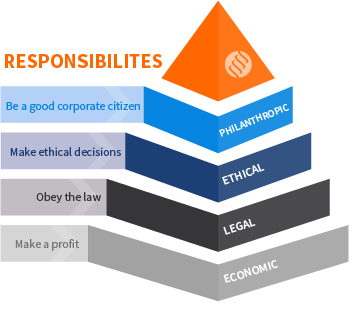
Developed in 1979 by Archie Carroll, the pyramid of corporate social responsibility is a four-tier guide to self-regulation as it relates to the morals and ethics of business. The pyramid itself is split into four levels, ranging from the most vital base level to levels that businesses should strive for as they develop and grow as a company.
The 4 Levels of the CSR Pyramid Explained
-
Level 1: Economic Responsibility
This is the base of the pyramid and is the responsibility of a business to stay profitable in order to continue existing. This is the base for all other responsibilities because if the business is not running, it can not accomplish the other levels.
-
Level 2: Legal Responsibility
This is the responsibility of a business to ensure that they are complying with the laws and regulations of the nation and/or location where they reside and do business. Following the regulations put in place by governing bodies to ensure fair and ethical business allows organizations to continue on the path towards overall corporate responsibility.
-
Level 3: Ethical Responsibility
This tier implies that businesses should operate in a fair and ethical manner. This can include going above and beyond what is required by law and making changes that reflect ethical decision-making by the business as a whole.
-
Level 4: Philanthropic Responsibility
This is the top tier of the pyramid and is a business’s effort to make a larger impact on their environment by creating a positive change in society and/or other non-self-serving areas. This can include donating to charities or putting an emphasis on sustainable business practices, for example.
What are the 3 P’s?
Also known as the Triple Bottom Line, the three P’s are the bottom-line measurement for the social and environmental impact of any given company.
1. People
This refers not only to the employees of a company, but to the people of the society in which a company operates in and has an effect on, as well. Internally, HR should set rules and regulations which are in line with the standards of the company and the welfare of its employees. In the community in which the company operates, the business should keep in mind how they impact the people around them, whether that is the people who live near the physical building of the company or those who buy the company’s products. They should make ethical decisions regarding these people and the pollution they create—waste, noise, and otherwise.
2. Planet
This refers to the planet Earth, the one on which all companies currently operate. Businesses should make ethical decisions in relation to their effects on the environment, positive or negative. When making business decisions, companies should attempt to minimize the harmful effects their business might have on the environment. They should also look to do good for the environment, such as using recycled materials, for example.
3. Profit
In order for a company to succeed and continue to exist as a company, it must generate a profit. In the past, this has been the main, and often only, consideration for businesses.
How can manufacturers incorporate corporate social responsibility (CSR) into their inventory management processes?
There are many ways for a company to be socially responsible. Here are a few examples:
- Avoiding Greenwashing
Greenwashing is when companies purposefully provide misleading information to consumers so they believe that the company is more environmentally friendly than it actually is. This can be harmful in many ways, including taking business away from actual green companies and instead putting it toward products that do more environmental harm.
- Adopt a Workplace Safety Program
Keeping the health and safety of employees in mind is vital to a sustainable business as well as talent retention. Ethical businesses are those that make employee wellness (both mental and physical) a top priority. In addition to maintaining strong morals, companies that take wellness into account will have more productive employees and retain talent as employees are more likely to enjoy being at that company.
- Hire with CSR in Mind
By hiring employees that fit into the culture of sustainability, companies can build their social responsibility practices from the ground up. Some candidates may be more sustainably inclined, or more willing to learn, which for many ethical businesses may be a huge leg up on other candidates. By integrating the ideas of social responsibility into company culture, a stronger foundation will be set for future sustainability endeavors.
LeanDNA helps manufacturers along the path to sustainability.
Learn more about how LeanDNA can be used for developing a sustainable supply chain.
FAQ
1. What is Carroll's CSR pyramid?
Carroll's CSR pyramid is a framework developed by Archie Carroll in 1991 that defines four levels of corporate social responsibility. From bottom to top: economic (be profitable), legal (obey the law), ethical (do what is right beyond legal requirements), and philanthropic (contribute to the community). The pyramid illustrates that each level builds on the one below it. A company must first be economically viable before it can meaningfully pursue higher-level responsibilities.
2. What are the 4 levels of corporate social responsibility?
The four levels of the CSR pyramid are: (1) Economic responsibility - the foundation; businesses must be profitable to survive and fulfill any other obligations. (2) Legal responsibility - operating within the law. (3) Ethical responsibility - acting fairly and honestly, even when not legally required. (4) Philanthropic responsibility - voluntarily contributing to society through charitable giving, community programs, or environmental initiatives. Carroll's framework holds that all four are expected of corporations.
3. How does the CSR pyramid apply to manufacturing?
For manufacturers, the CSR pyramid provides a practical hierarchy for sustainability and social responsibility efforts. Economic responsibility means running an efficient, profitable operation. Legal responsibility means meeting environmental, labor, and safety regulations. Ethical responsibility means fair supplier treatment, safe working conditions, and honest reporting. Philanthropic responsibility includes community investment and environmental stewardship programs, areas where manufacturers increasingly face scrutiny from customers, investors, and regulators.
Digital transformation is key to achieving your sustainability goals.
Sustainable manufacturing is becoming increasingly accessible as technology advances strategies and automation frees up supply chain workers to focus on more challenging initiatives. Are you considering changing up your tech stack?
See the 5 ways digital transformation is shaking up inventory management solutions.
Share the secrets to lean manufacturing.
Lean is key when it comes to sustainable manufacturing initiatives. Investopedia defines the theory of Lean Six Sigma as aiming to “improve performance” by “eliminating resource waste and defects.” Less waste means less harmful impact on the environment, and more savings for your business.
See how Paul Aram of Ingersoll Rand was able to implement the principles of Lean.