Written by Aaron Phillips, Product Manager, LeanDNA
Article Summary
- LeanDNA is launching Demand Scenario Modeling (DSM) in APEX, a new capability that lets production planning teams test demand changes directly against live supply data and multi-level BOM structure, without spreadsheets or ERP risk.
- Early customers are seeing 6-10x faster scenario analysis compared to their previous Excel-based process.
- LeanDNA is hosting a live webinar on September 23rd at 11:00 AM CT to show how it works.
Scenario modeling in discrete manufacturing
For years, production planners have solved the same problem the same way. When demand shifts or a new request comes in from sales or leadership, someone on the planning team has to figure out whether supply can actually support it, and almost without exception, that process starts with a spreadsheet. They export ERP data, flatten the BOM, reconcile supply manually, and spend hours building a model that's already disconnected from reality by the time it reaches the right person. Some teams go further and key fake orders directly into their ERP just to test a scenario, introducing system risk and data quality problems on top of the time they've already lost.
This is not a lack of scenario modeling, but rather scenario modeling trapped inside a broken workflow, and it is a problem that grows more expensive as demand volatility increases and customer commitments become harder to walk back.
Today, LeanDNA is introducing Demand Scenario Modeling in APEX to fix that broken process.
What Demand Scenario Modeling does + key benefits for production planning
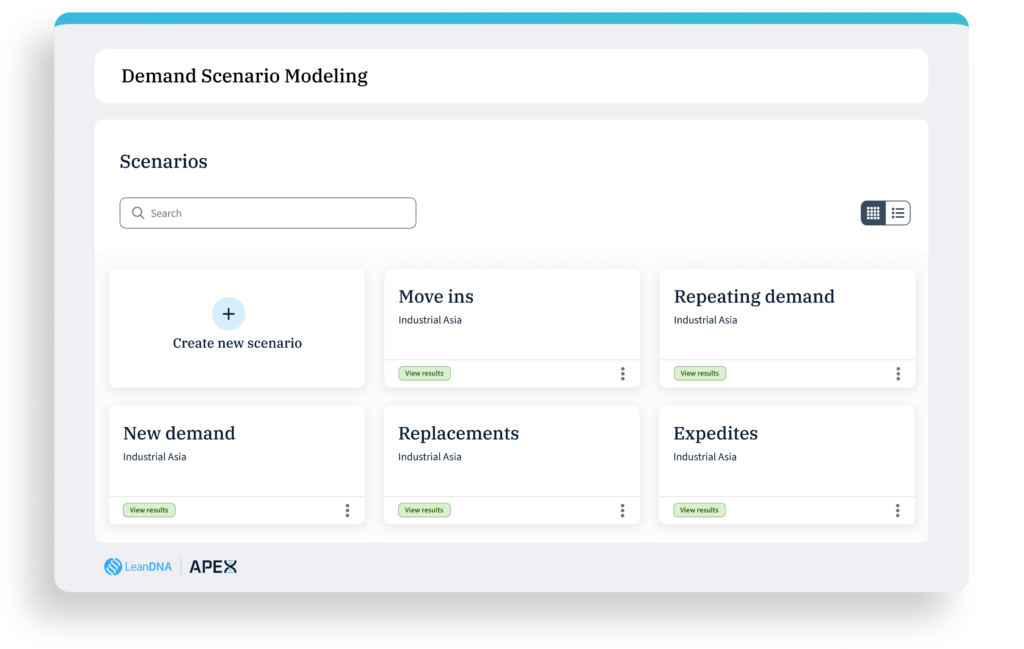
Demand Scenario Modeling is now available in APEX, giving production planning teams a fast, safe, and supply-connected way to answer the question manufacturers face every week: can we actually support this demand change?
Rather than exporting data and rebuilding BOMs in a spreadsheet, planners can now test demand changes directly inside APEX against real supply conditions and multi-level BOM structure. Whether the request is a pull-in, a push-out, a quantity modification, or a net new order, the tool surfaces which components truly constrain production, how many units can realistically be built, and where shortage risk increases under different demand assumptions. The entire workflow runs in a safe sandbox environment that never touches live ERP records, so teams can model freely without the operational risk that comes with temporary orders or manual system manipulation.
Early customers are seeing 6-10x faster scenario analysis compared to their previous Excel-based process, with results that reflect the full complexity of their BOM structure rather than a flattened approximation of it.
Why the spreadsheet workflow is more costly than it appears
Since manufacturing environments are inherently dynamic, the decisions made in response to demand changes can cascade through hundreds or thousands of components across a multi-level BOM. The traditional production planning process assumes teams can create a good production plan, execute against it, and periodically replan when reality changes. The real challenge is what happens between those planning cycles, when a new customer request arrives, a program ramp accelerates, or sales asks whether an order can be pulled forward before the next MRP run. When answering a what-if question takes hours or days, planning teams naturally evaluate fewer alternatives. The decision-making process slows down, and when time runs out, decisions fall back on intuition and tribal knowledge rather than data grounded in real supply conditions.
A what-if analysis that takes three hours produces a different kind of decision-making culture than one that takes fifteen minutes. When the friction is low enough, teams run more scenarios, evaluate more alternatives, and make more confident commitments. That is the shift Demand Scenario Modeling is designed to create.
What makes DSM different from other production planning tools
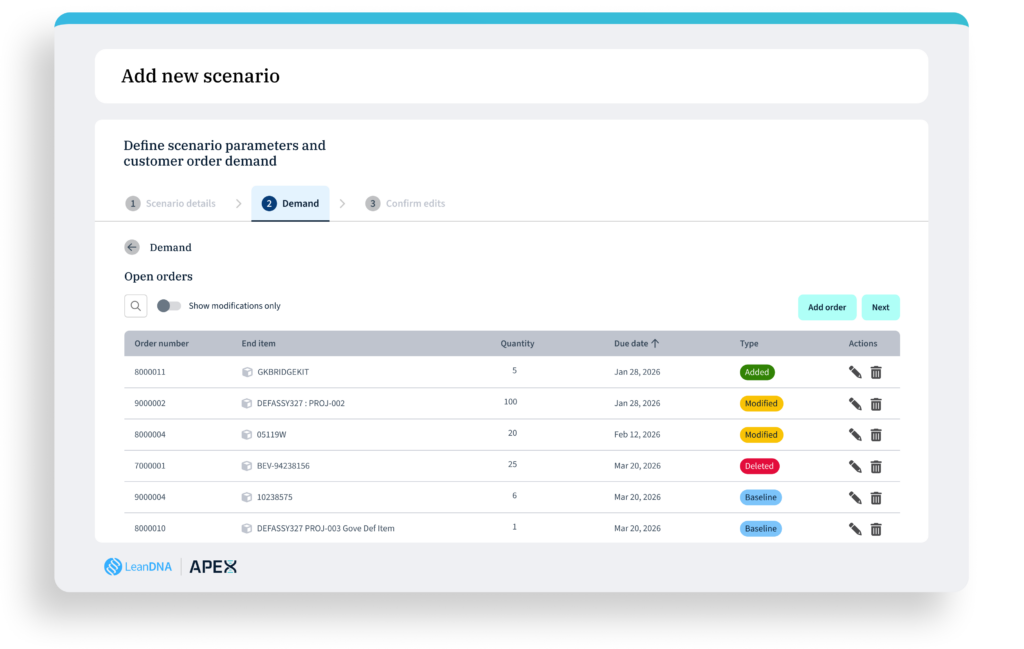
Most what-if analysis tools available to discrete manufacturers fall into one of two categories, and neither one serves the production planning team particularly well. Enterprise scenario planning platforms are built for network-level modeling and long-horizon demand planning, which means they operate at a level of abstraction that is useful for S&OP and executive planning but disconnected from the site-level execution decisions that production planners are making every day. Lighter tools let teams add demand and see a line of balance change, but they flatten the BOM in the process, which introduces noise that buries the real constraints and sends planning teams chasing false shortages rather than the components that actually block production.
Demand Scenario Modeling in APEX sits in the space between those two categories, designed specifically for near-to-midterm, site-level production planning where real commitments are made and where the accuracy of the constraint picture has direct consequences for customer delivery and operational performance.
Three capabilities make it meaningfully different from the spreadsheet-based what-if analysis process most teams are relying on today.
- Scenarios run against live inventory, supply orders, and multi-level BOM data pulled directly from the ERP, which means there are no manual exports, no stale data, and no models that diverge from the real supply picture as soon as they are built.
- Everything runs in an ERP-safe sandbox, so nothing writes back to the ERP or the APEX environment, eliminating the operational risk and data quality issues that come with fake orders or temporary system entries.
- Because DSM preserves multi-level BOM structure rather than flattening it, shared component constraints are aggregated automatically, so the shortages that surface reflect what is actually blocking production rather than what a simplified model approximates.
Common scenario modeling use cases
Production planning teams are using Demand Scenario Modeling across a range of recurring scenarios that previously required manual spreadsheet analysis. When sales asks whether a new order can be absorbed, planners can add the demand, run the scenario, and see immediately whether supply can support it and which components create risk. When a customer requests a pull-in, the team can adjust the required date, rerun the scenario, and see how supply reallocates across existing orders before making any ERP changes. When quantities change, planners can update the demand line and surface new shortages or available capacity in minutes. When multiple changes arrive at once, all of them can be modeled in a single scenario to produce one holistic view of the net impact across the full BOM.
DSM models the recurring situations that production planners deal with every week, and they are the situations where the cost of a slow or inaccurate answer is highest.
The bigger shift in production planning with DSM
Supply chain technology has historically focused on two capabilities: forecasting what demand is likely to be, and providing visibility into what is happening now. Both remain essential, but there is a third capability that manufacturers need and that most tools do not provide well: the ability to reason about what happens if the plan changes.
Scenario modeling closes that gap by giving planning teams a structured, repeatable way to pressure-test decisions before they are made. Manufacturers can take a new piece of information, evaluate its downstream impact across the BOM, understand the tradeoffs between different responses, and commit with confidence before the problem reaches the factory floor. The companies that build this capability into their daily planning process will be better positioned to respond to demand volatility, protect customer commitments, and make operational decisions faster than their competitors.
See it live
LeanDNA is hosting a live webinar on September 23rd at 11:00 AM CT to walk through Demand Scenario Modeling in APEX, including a full product demo and a chance to ask questions directly to the product and customer success team..
Register for the webinar | Learn more about Demand Scenario Modeling