Written by Richard Lebovitz and Sheetal Kakkad
Every supply chain leader has heard the same AI pitch on repeat.
Generic copilots. Black-box “optimization.” Slick demos that fall apart the moment you ask about a real supplier, a messy ERP, or a part that never behaves like it should.
Kei was born from a very different question:
What if you could talk to your own supply chain, in your own words, and get clear, trustworthy answers back in seconds?
This is the story of why we built Kei, how it differs from other AI in supply chain, what customers are doing with it today, and where it is headed next inside the APEX platform by LeanDNA.
APEX is AI-powered expert execution through a factory-first platform, enabling supply chain teams to execute with peak intelligence, precision, and domain knowledge. Kei is how that expertise starts to speak back.
Why Kei Was Created
As modern LLMs matured into tools that teams could reliably use and scale, we recognized an opportunity forming:
- LLMs were getting good enough to converse like an expert.
- Our own platform had advanced to a point where traditional knowledge base and help documentation wasn’t going to keep up.
We were already investing heavily in advanced analytics, Inventory Optimization, and a Data & AI Engine that turns ERP and supplier data into a single, enriched source of truth.
The problem was familiar to anyone who has rolled out complex software:
- Knowledge bases age the moment you publish them
- Tooltips can explain individual components, not an entire workflow
- No one reads 300-page help documents about safety stock strategy, no matter how good the math is
So the first idea for Kei was not magic. It was simple:
Could we use an LLM to answer all the “What does this mean?” and “Where do I find that?” questions inside APEX, in plain language?
One of our engineers put together a proof-of-concept prototype. You could ask a single question, get a single answer, and that was it. Almost like a smarter search box.
Seeing that prototype sparked the bigger idea:
If we can answer questions about documentation, why not answer questions about the data itself?
From there, Kei evolved quickly:
- From static help to interactive conversations about your live data
- From “chatbot” to AI agent that can call tools, query datasets, and generate formatted and readable output
- From simple Q&A to contextual analysis grounded in APEX’s Data & AI Engine, not the open internet
The intent never changed:
Make complex supply chain intelligence simple to use, so more people can make better decisions every day.
The Origin Story Of The Name
Kei is not a random three-letter brand name; it is a tribute.
Three decades ago, when lean manufacturing practices were just beginning to spread outside Japan, Richard Lebovitz worked closely with a Japanese consultant named Kei Abe. Kei never chased the spotlight, yet he shaped factories on three continents.
His background read like a history of modern manufacturing:
- Aerospace engineer at Honda
- Work with Shigeo Shingo and early on at Toyota quick-changeover initiatives
- Consulting through the Japanese Management Association, then globally as one of the first to bring lean outside of Japan
The companies he helped are now case studies. One of his clients eventually sold for tens of billions of dollars. Kei’s name rarely appears in the public record, but his fingerprints are everywhere.
Driving this legacy was his philosophy, which shows up in APEX and Kei the AI Assistant:
- Make things simple. If you make the work performed by people easy to understand, they move faster and make fewer mistakes. That was true on the factory floor thirty years ago, and it is just as true in software today.
- Make it visual and easy to use. Good systems remove intimidation, so when something feels natural to use, you do not need to push adoption. People come back because it helps.
- Teach in a way that lets ideas come out of their mouths, not yours. His goal with every engagement was to embed the mindset so deeply that the local team owned it. The same idea sits behind Kei the AI Assistant: it puts power into the hands of buyers, planners, analysts, supervisors, and executives, rather than relying on outdated processes or outside experts.
Naming our AI “Kei” is our way of honoring that legacy. Kei Abe helped people see factories differently, and now Kei, the AI Assistant, helps people see their supply chain data differently.
Did We Expect The Response From Customers?
Short answer: no. We believed Kei would be useful, but we did not anticipate how quickly customers would lean in.
From the first unveil, the reaction clustered around a few themes:
- “It actually understands our data.” Users asked highly specific questions about parts, sites, and suppliers and saw accurate answers grounded in their reality, not generic theory.
- “I do not have to build another report for this.” Analysts in particular started using Kei as a faster way to interrogate complex datasets instead of wiring up new BI views for every question.
- “This finally makes the advanced stuff accessible.” Concepts like demand profiling, PFEP strategies, and simulation comparison can intimidate new users. Kei helps explain and navigate them without sending someone to a training binder first.
Was the excitement predictable in hindsight? Probably. It lines up with a simple distinction noted across the technology industry:
Search returns results. AI gives you answers.
Once customers experienced that difference on top of their own APEX data, adoption followed quickly.
How Kei Is Different From Other Supply Chain AI
There is no shortage of AI in supply chain technology. Most of it falls into two buckets:
- Generic LLMs with no access to your real data
- Black-box optimization tools that produce plans, then stop at the handoff to execution
Kei is different on a few fronts.
1. It is built on your supply chain, not just the public internet
Kei sits directly on top of the APEX Data & AI Engine, which centralizes and standardizes supply planning data across ERPs, sites, and supplier systems into a single source of truth.
- It sees the same cleansed, enriched data that powers Supply Insights (including clear-to-build and line of balance reports), Procurement Management (including shortage actions, supplier management, and inventory actions), and Inventory Optimization (including PFEP analysis and simulation)
- It understands manufacturing-specific models like PFEP, demand profiles, order policies, and safety stock strategies
- It respects strict data security constraints, querying your data, but never using it to train public models
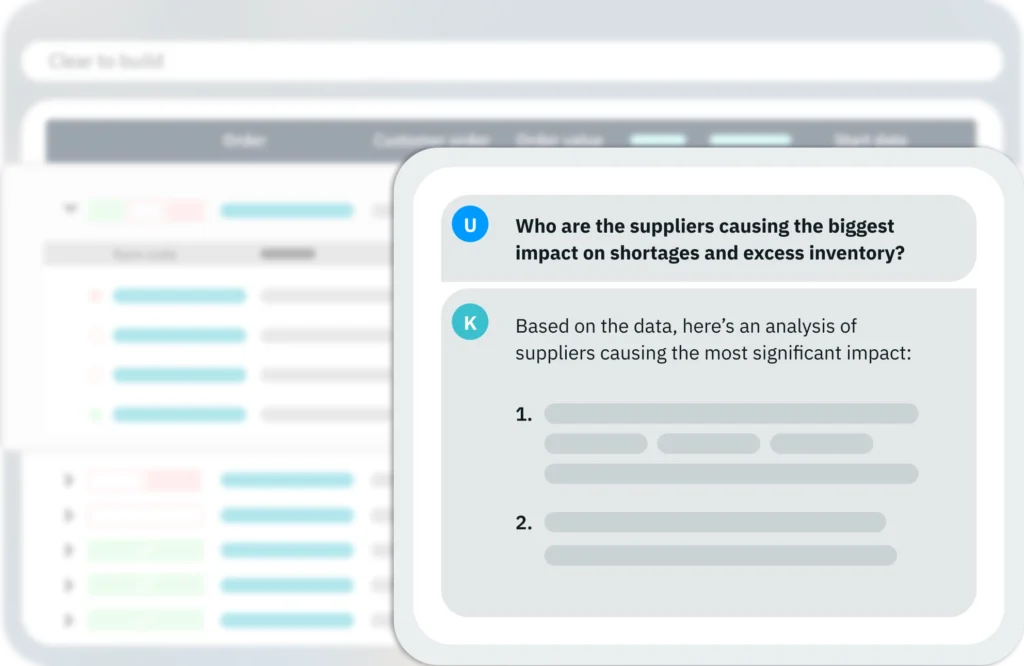
You are not asking a public chatbot abstract questions about MRP. You are asking an assistant that can look directly at your current shortages, your PO history, your inventory levels, your simulation results, your supplier compliance, and so on.
2. It behaves like an AI agent, not just a chat window
Kei is wired into tools and skills across the platform, which means it can:
- Query datasets across sites, policies, and time
- Run targeted analyses for specific use cases
- Format answers as tables, ranked lists, or narratives depending on what you need
- Query different types of data simultaneously and merge them into a coherent analysis
Inside APEX, we think of Kei less as a “chatbot” and more as a supply chain assistant with a growing skill set.
3. It is tuned for specific roles and workflows
Many AI tools treat every user the same. Kei is intentionally built around the personas that drive supply planning and execution.
- A buyer may ask, “Which POs should I move this week to protect production with minimal cost?”
- A planner may ask, “What items will be clear to build this week?”
- An analyst might ask, “Compare service level outcomes for these two safety stock scenarios across my AX parts.”
- A director might ask, “Where is my site performance deteriorating, and which suppliers are driving it?”
The questions are different, so the answers are different. Kei responds with the right abstraction level and format for each.
4. It focuses on action, not just analysis
Because Kei lives inside an execution platform, it is never about insights alone. It is there to help you:
- See what is happening
- Understand why it’s happening
- Decide what to do next, today
In other words, Kei helps close the loop between data, decision, and action, which is the core DNA of the APEX platform.
The Value We Are Already Seeing
Even in these early stages, Kei is shifting how teams work.
Faster time from question to answer
Before Kei, answering a non-trivial question often meant:
- Pulling data from ERP and APEX
- Cleaning and reshaping it in Excel or a BI tool
- Building a custom view or pivot
- Interpreting the result and packaging it for others
Now, many of those cycles collapse into a single question.
That matters for buyers and planners managing hundreds or thousands of parts, and it matters for analysts who can now spend more time on strategy than on report building. It is the same productivity story we have seen when customers moved from spreadsheets to APEX in the first place, now accelerated again with conversational intelligence.
On-demand expertise instead of static documentation
We have an enormous amount of embedded know-how inside APEX, and Kei makes that expertise easier to access in the flow of work, which:
- Improves confidence in decision making
- Improves adoption of capabilities like Supply Insights, Procurement Management, and Inventory Optimization
- Reduces dependency on long training sessions and reference guides
- Raises the baseline level of supply chain literacy across teams
Education and empowerment, not job displacement
In an environment where AI is often framed as a threat to jobs, Kei plays a different role.
The work most people want to automate is not strategic thinking or problem solving. It is the endless spreadsheet wrangling, status chasing, and manual reconciliation.
By removing those cycles, Kei:
- Gives buyers more time to strengthen supplier relationships
- Gives planners more time to shape strategy instead of just reacting
- Gives analysts more time to design better policies and experiments
In other words, it lets people get to the work they never had time for. Kei removes the cycles that create unnecessary overtime, so you can make smarter decisions faster — and be home in time for dinner.
Kei In The Wild: Use Cases Today
Kei is already supporting a wide range of day-to-day work inside APEX. A few examples bring it to life.
1. “What is going to stop me from shipping next week?”
A planner working inside Clear to Build wants to know which parts are putting the next seven days of production at risk.
Instead of clicking through multiple reports, they can ask:
“Show me the top ten parts likely to block production in the next week, and tell me which orders they affect.”
Kei will:
- Scan upcoming production orders and requirements
- Cross-reference on-hand, inbound supply, and risk scores
- Return a ranked list of parts, the impacted orders, and recommended actions
From there, the planner can drill down:
“Do we have POs placed for these parts?”
Kei responds with current PO status, commit dates, and gaps.
The result: Fewer surprises on the floor, faster prioritization of true blockers.
2. “Are my inventory policies set up correctly for this demand pattern?”
An analyst configuring Inventory Optimization is working through a PFEP strategy and new service level targets. They might ask:
“For AX parts with short lead times, are my current service levels too low compared to recommended settings?”
Kei understands:
- What “AX” means in the context of ABC and demand profile classification
- The existing PFEP matrix and policy rules
- The analyst’s simulation results and KPIs
It can respond with:
- Specific groups where service levels should be raised or lowered
- Expected impact on shortages and inventory if changes are applied
- Suggestions for a follow-up simulation, for instance, “Increase service level from 95% to 97% for these items and rerun”
This replaces days of spreadsheet work and bespoke dashboards with a single dialog.
3. “Why is this supplier always a problem?”
A VP of Operations wants a quick read on supplier risk.
A question as simple as:
“Which three suppliers are driving the most production risk at Site A this quarter, and why?”
prompts Kei to:
- Look across shortages, late POs, expedites, and performance metrics
- Summarize patterns in late deliveries, quality issues, or chronic past-dues
- Offer suggested actions, such as shifting volume, renegotiating terms, or reviewing order policies for affected parts
The answer is not another static slide. It is a live analysis you can refine on the spot.
4. “Explain this concept to me before I act on it”
Not every question is analytical. Sometimes a user just needs to understand a concept well enough to feel confident.
- “What does service level really mean in the context of safety stock?”
- “Explain ABC demand profiling in simple terms, then show me how it applies to my B variable items.”
Kei can teach and analyze in the same breath, which supports ongoing learning without leaving the task at hand.
Where Kei Is Going Next
Kei today is a powerful assistant inside the APEX platform. Looking ahead, we see it becoming an even more natural part of how teams understand their data, make decisions, and improve execution.
1. From assistant to intelligence woven throughout APEX
Over time, we envision Kei showing up in more places where questions naturally arise. That can mean context-aware explanations, clearer guidance inside workflows, or narrative insights that help users understand what they are seeing without leaving the screen.
The idea is simple: bring the intelligence closer to the work, so the answer you need meets you where you already are.
2. A tighter loop between optimization, execution, and learning
The long-term direction for APEX is a system that not only helps teams optimize and execute but also learns from how the real world responds. We see Kei playing a key role in that loop.
Kei can help people ask smarter questions, interpret outcomes, and understand why things behaved the way they did. And as AI models continue to advance, we expect its ability to reflect on past responses, assess confidence, and improve over time to expand as well.
The goal is steady, forward progress: a system that becomes more insightful, more grounded, and more helpful.
3. Growing with the expanding scope of APEX
As APEX continues to broaden its reach across planning, sourcing, execution, and optimization, Kei will evolve alongside it. We expect its skill set to expand into new areas of supply chain decision making, new types of analysis, and new ways of supporting the diverse roles that rely on APEX every day.
What will stay constant is the philosophy behind it:
- Keep intelligence simple and approachable
- Make advanced concepts easy to understand
- Put power in the hands of the people closest to the work
Kei’s future is not just more features. It is a widening circle of support that helps every user think more clearly, act more confidently, and improve continuously.
Closing: An Analyst On Demand For Every Factory
Supply chains will not get simpler, and data volumes will not shrink. The expectations on planning and procurement teams will not relax.
What can change is how those teams experience their work.
Kei was created so that a buyer facing a sea of POs, a planner staring down a volatile forecast, or a director trying to understand site performance can all do the same simple thing:
Ask a clear question, get a clear answer, and act with confidence on real data.
In a world where search returns results, Kei is here to give answers.
Learn more about Kei: chat with one of our experts today.