Based on insights from Aaron Phillips, Product Manager at LeanDNA.
In complex manufacturing, the production plan and the shop floor reality are rarely the same thing. A planner's job in the supply chain planning process is to close that gap before it becomes visible, catching material shortages, late purchase orders, and supply mismatches before they stall a line or blow a delivery commitment. That requires accurate, timely information at the order level, leveraging up-to-date data. In most environments, obtaining this information requires manually combining data from multiple systems under tight time constraints every day.
Clear to Build, part of the APEX platform by LeanDNA, was built to replace that manual process with a modern software solution that streamlines production and helps optimize resources.
Why Production Planners Can't Rely on ERP Alone
Before a production order gets released to the floor, someone has to verify that all required components and raw materials are available or arriving on time. In most manufacturing environments, that verification happens manually. Planners pull data from ERPs, MRPs, and supply chain planning software, check inventory management records, review open purchase orders, and review the bill of materials (BOM) level by level to assess what's ready and what's missing.
For a production order with a shallow BOM and a handful of purchased components, that process is tedious but manageable. For a complex assembly with hundreds or thousands of child items across multiple BOM tiers, it can consume most of a planner's day. And it still produces an incomplete picture. For example, the manual process makes it easy to miss a late sub-assembly several levels deep that will block final assembly weeks from now.
When planners release orders without full visibility into production readiness, the consequences land on the shop floor. Incomplete builds sit on the shop floor, production lines come to a halt because parts haven't arrived, and buyers get urgent calls to expedite purchase orders at a premium. Customer delivery commitments slip, reducing customer satisfaction and risking repeat business. Over time, buyers start over-ordering to hedge against the next shortage, which drives excess inventory and increases costs.
ERP and MRP systems were not designed to prevent this. They hold the data and generate planning signals, but they do not synthesize that data into a clear, order-level answer about production readiness or provide understanding and execution capabilities. That translation still falls to the planner, making it difficult to create a good production plan that can meet customer demand and keep operations running smoothly.
What Clear to Build in APEX Actually Shows You
Clear to Build in the APEX platform analyzes every production order in your system and evaluates each component requirement against available and incoming supply within your supply chain operations. The tool leverages supply-demand pegging to trace material availability across orders and BOM levels. For each requirement, it assigns one of four statuses: supply is on hand, expected in time, expected to delay the order, or no supply identified. A production order is considered "clear to build" only when every component meets one of the first two criteria, ensuring planning accuracy and helping to meet demand effectively.
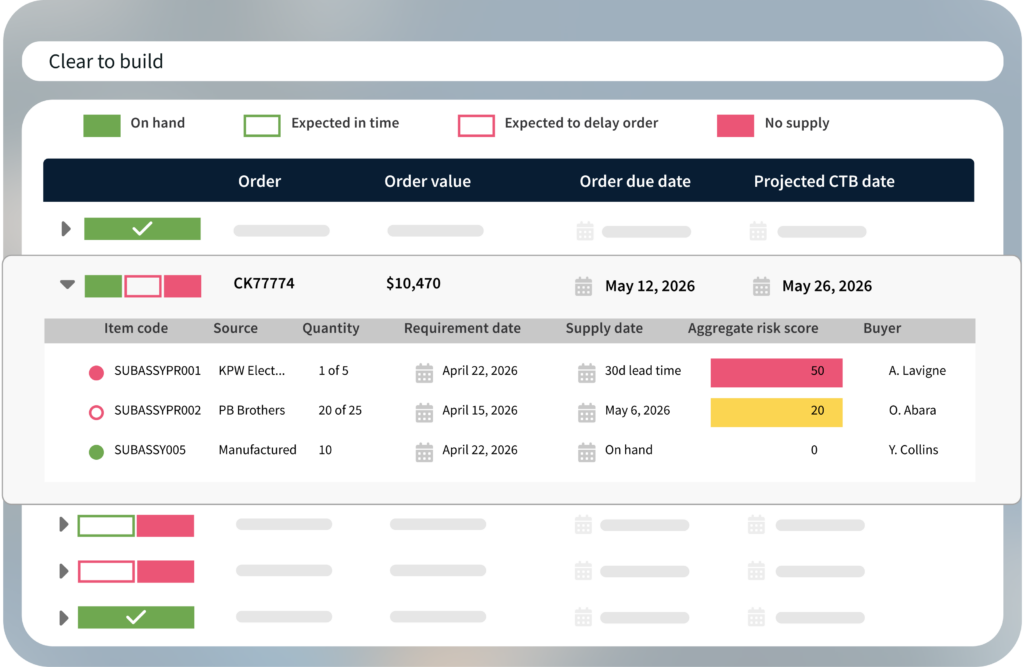
The four-status framework matters because it gives planners useful gradations, not just a binary pass or fail. A component that is expected in time but cutting it close looks different from one with no supply order at all. The report surfaces these distinctions, along with the supply order associated with each at-risk requirement, the buyer responsible, the exact depth of delay in days, and a projected date when all materials are expected to be available, supporting smarter decisions in production planning.
For manufacturers with multi-level assemblies, the multi-level version of the Clear to Build report identifies the single component that determines whether the entire order can be built, from finished goods to sub-assemblies to purchased components. This detailed view is crucial in the production planning process because the root cause of a production delay is often several levels removed from where the planner first notices the problem. Multi-level Clear to Build reporting surfaces actual bottlenecks, not just downstream effects, enabling better resource allocation and reducing waste in manufacturing processes.
How Planners Use Clear to Build Reporting Day to Day
Starting the day with a clear picture:
The most common workflow starts with a simple filter: show me all orders where every component is on hand or expected in time. That filtered view becomes the release queue for the day. Planners sort by due date to prioritize the most urgent builds and release orders to the shop floor with confidence that the materials will be there when production needs them, helping to avoid delays and improve overall productivity.
For orders that are not yet ready, planners expand the bill of materials to see exactly which components are causing the blockage and who owns the associated purchase orders. This supplier management insight routes the problem directly to the right buyer, with enough context to act, rather than triggering a separate investigation. This seamless order management control supports better decision making and helps mitigate risks in the production process.
Using the projected clear-to-build date:
The projected clear-to-build date shows when a blocked order is expected to have all materials available, based on current supply order commit dates. Planners use this to realistically sequence upcoming work, communicate delivery timelines to customers, and decide whether to hold, move, or escalate an order before it affects the production schedule.
Flagging critical orders:
When an order is tied to a high-value customer commitment or a time-sensitive delivery window, planners can set a priority flag on it in Clear to Build. That flag flows downstream to the buyers managing the associated purchase orders and, where the APEX supplier portal (Supplier Connect) is active, priority flags flow directly to the supplier. Rather than sending a separate message or relying on a buyer to check the right report, the urgency is surfaced automatically to the people who can act on it, helping to reduce costs and avoid delays in the production process.
How Other Teams Benefit from Clear to Build
Buyers
A buyer's default state is a long list of open purchase orders with no clear signal about which ones actually matter right now. Clear to Build changes that by surfacing exactly which POs are blocking production orders. When a planner flags a critical build, the priority flows directly to the buyer managing the related components. They know that securing an updated commit date or expediting that specific order has a direct, traceable impact on production. That focus is hard to achieve any other way, helping buyers respond quickly to supply chain disruptions and reduce lead times.
Suppliers
Suppliers connected through the APEX Supplier Connect portal can see priority flags, updated commit date requests, and supply order notes. They can respond by updating commit dates and providing tracking information directly in the platform. This supplier view into your supply chain planning software streamlines communication that previously happened through email threads and phone calls, often without full context on either side, replacing it with shared understanding into what is needed and when.
Site leaders and operations managers
Site leaders use Clear to Build to get a fast read on production health across the site. The report shows what share of the order book is ready to build, where the concentrated shortages are, and which blocked orders carry the most value. Sorting by order value is particularly useful because it shifts the conversation from operational noise to revenue impact, helping leadership direct resources needed where they will actually matter. This integrated visibility helps track progress against production goals, ensuring cost effective operations.
Executives
Executives typically do not need the detail of the Clear to Build report, but they do benefit from what it enables. APEX site performance dashboards surface the clear-to-build percentage as a rolled-up metric, giving executives a reliable indicator of production readiness without requiring them to interpret order-level data. More broadly, having planning, procurement, and operations working from consistent, shared data reduces the time leadership spends reconciling conflicting views of the same situation, aligning supply chain planning software efforts with overall business strategy and market trends.
The Business Outcomes of Clear to Build
The direct benefits of Clear to Build show up in a handful of areas that manufacturing operations teams track closely.
Expedite costs go down when shortages are identified early. Teams that know a component is going to be late three weeks before it affects production have time to find alternatives or negotiate better outcomes. Teams that discover it on the day of the build do not.
Throughput improves when planners stop releasing orders that cannot be completed. Incomplete builds stall on the shop floor, consume capacity, and tie up components that could otherwise support orders that are actually ready to ship. Filtering those out before release keeps production moving and supports effective supply chain planning.
On-time delivery becomes more predictable because production commitments are grounded in actual material availability. The projected clear-to-build date gives planners a defensible basis for the delivery dates they communicate to customers, and it gives them early warning when a date is at risk.
Production planning teams recover significant time. The hours that previously went into manually reconciling supply data across systems get redirected to actual planning work. According to LeanDNA customers, what used to require hours of investigation can now be assessed in minutes, enhancing job production planning and batch production planning efficiency.
Cross-functional coordination tightens because everyone is working from the same unified view. Buyers know which purchase orders matter most, suppliers know what is urgent, and site leaders can see the overall picture without commissioning a separate report. The shared visibility reduces the coordination overhead that normally falls on production planners to manage manually.
By integrating Clear to Build within a comprehensive supply chain planning software platform, manufacturers gain up-to-date insights into production readiness. This alignment helps achieve the main goal of supply chain planning software: ensuring products are available at the right time, place, and quantity while minimizing costs and maximizing efficiency.
A Foundational Capability for Production Planning
Clear to Build started as one of LeanDNA's earliest products because the problem it solves is genuinely foundational to effective supply chain planning software. Every other effort to improve production efficiency, reduce shortages, or hit delivery targets depends on someone having an accurate answer to a deceptively simple question: what can we build, and what is in the way?
As part of APEX by LeanDNA, Clear to Build connects that answer to the broader supply chain planning software platform, giving procurement, supplier collaboration, and site performance analytics a shared foundation of production readiness data.
For teams using it today, Clear to Build tends to become one of those indispensable tools in supply chain planning software that is hard to imagine operating without, especially when managing complex production schedules involving identical items and coordinating forecasting demand across multiple suppliers and production lines.
See Clear to Build in Action
Clear to Build is part of APEX by LeanDNA, the factory-first AI platform for supply planning and production readiness. To see how it works in practice, schedule a demo with our team.