Based on insights from Adam Baker, Staff Product Manager at LeanDNA.
TL;DR
- Line of Balance (LOB) is a part-level supply and demand projection tool that provides up-to-date visibility—daily, weekly, or monthly—showing exactly which parts are currently short and which will face shortages in the coming weeks. End Item Line of Balance (End Item LOB) extends this projection to finished goods and all their component parts.
- Traditional manual processes using Excel require rebuilding the projection every day, causing loss of valuable purchase data, supplier performance notes, and prioritization context. In contrast, APEX’s automated system refreshes projections daily, preserving historical data and enabling effective purchase order management.
- Visibility alone is not enough. LOB and End Item LOB tell buyers and planners where to look; integrated with APEX’s Workbench, Clear to Build, and supplier collaboration features, they provide actionable insights and enable supply chain managers to eliminate bottlenecks and ensure timely action, improving operational efficiency.
From Visibility to Action: How Line of Balance Empowers Supply Chain Teams
Every manufacturing site knows the ritual. The daily shortage meeting begins, a list of parts appears, and the same critical questions arise: Where are we today? How fast can we recover? What upcoming supply risks should we prepare for?
Answering these questions effectively requires two key elements: a reliable, data-driven projection of supply and demand at the part level, and a seamless connection from that projection to actionable steps. Line of Balance (LOB) and End Item Line of Balance (End Item LOB) in APEX deliver precise, up-to-date inventory management insights and supply chain analytics. Because they integrate directly with APEX’s Workbench, Clear to Build, and supplier collaboration tools, they enable efficient resource allocation and clear communication across the supply chain.
This integration transforms LOB from a simple visibility report into an essential component of a comprehensive procurement process workflow: identify shortages, execute purchase order management actions, and collaborate with suppliers to prevent future disruptions. By leveraging advanced technology and up-to-date data, APEX empowers procurement teams and production planners to make informed decisions, improve accuracy, and optimize inventory management, ultimately driving cost savings and better supplier relationships.
The pain: spreadsheets that expire every 24 hours
Without a tool like APEX, teams build line of balance projections themselves. The data lives in the ERP, so a buyer or another user exports all supply and all demand, pivots it into weekly totals, subtracts demand from supply, and gets a projection. Getting the data is the easy part.
The hard part is everything after:
- It expires daily. The Wednesday file helps the Wednesday meeting. Thursday needs a new export, a new pivot, a new file.
- Knowledge does not carry forward. Notes, comments, and prioritization decisions made on Wednesday have to be manually transferred into Thursday's file, or they are lost.
- Prioritization resets. If the team deprioritized five of twenty parts yesterday, someone has to remember which five when today's file is rebuilt.
- Insight is disconnected from action. Even a perfect spreadsheet projection cannot show you the purchase orders behind a shortage, message a supplier, or record what was done about it. That work happens in other screens, inboxes, and phone calls.
The result is a daily cycle of manual rebuilding, lost context, and firefighting, exactly the kind of fragmented workflow that keeps supply chain teams reactive instead of proactive.
What is Line of Balance?
Line of Balance (LOB) is a part-level inventory projection that can be viewed daily, weekly, or monthly. It looks at what you have on hand today, plus all future supply and demand, and tells you the projected health of every item over time.
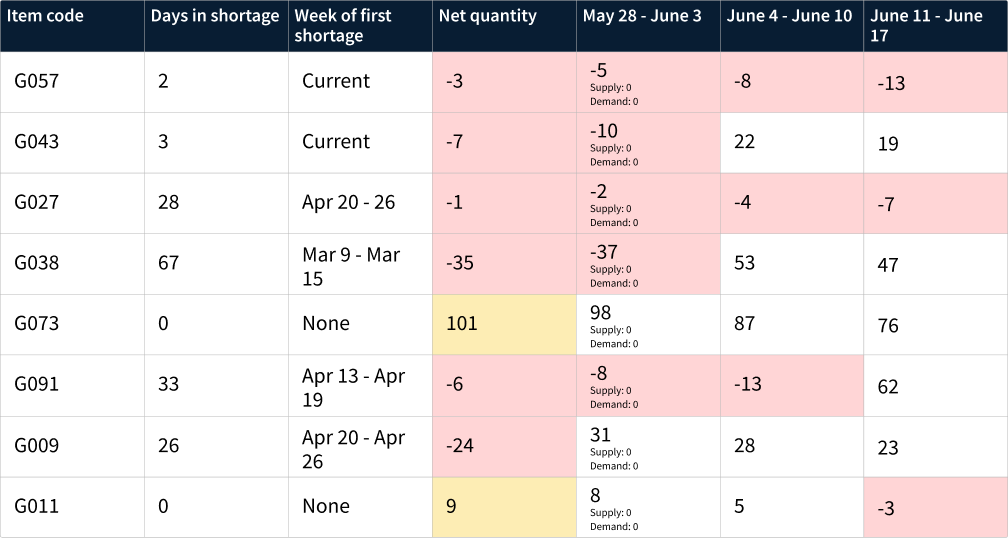
For any part, LOB answers questions like:
- Are we good or short today?
- We are short this week. Do we recover next week?
- We look healthy today. Do we go short two weeks from now?
Because APEX refreshes this projection automatically, the report that took a buyer an export-and-pivot session to build in Excel is simply there every morning, with yesterday's comments, statuses, and priorities intact.
What is End Item Line of Balance?
End Item Line of Balance applies the same projection logic one or more levels up the bill of materials, at the level of the finished product you build and sell. Supply becomes production orders, and demand becomes sales orders.
End Item LOB is deliberately high level, while Clear to Build gives you more detailed breakdowns, pinpointing specific production orders, allocations, and dates for a go/no-go decision on starting production. End Item LOB gives you the big picture view, a quick read on whether the items you build repeatedly will be healthy in a few days, a few weeks, or a month, so you can spot bottlenecks before they become fire drills.
The powerful part is the expansion of end items in the report. From any end item, you can expand to see the line of balance for every component part required to build it. That surfaces a risk pattern that is easy to miss: your end item looks healthy today, but the projections for its component parts are deteriorating. You may be scraping by now, but one more customer order pushes those components short and your end item health degrades into the future. End Item LOB lets you see that coming.
The buyer workflow: from projection to purchase order management
The most common LOB user is the buyer, and the shortage meeting is the classic scenario. Here is how the workflow runs in APEX:
- Filter to current shortages. A site might have 10,000 parts and 100 current shortages. The buyer starts with the parts that are red today.
- Drill into supply. Click into the part to see the supply and demand detail behind the projection, or jump to Workbench to see every open purchase order for that item. This is where LOB hands off to purchase order management: is there a PO covering the shortage, and can it come in faster?
- Act and collaborate. From Workbench, the buyer messages the supplier directly in APEX. We are short four , the PO is due in five days, can you get it here in three? If no PO exists, the buyer places one.
- Prevent the repeat. Before closing the loop, the buyer checks next week's projection. Are POs aligned to keep this part off next week's shortage list, or does something need to move now?
Because the Line of Balance report, the PO detail, the supplier conversation, and the notes all live in one platform, a buyer can walk into Thursday's meeting with the recovery plan already documented. Better still, teams get closer to not needing the meeting at all. When a buyer updates a supplier commitment in Workbench, anyone who depends on that part can see the latest status directly in the platform instead of waiting for a status readout.
The planner workflow: a full picture of production health
For End Item Line of Balance, the primary users are planners, schedulers, and program managers, often the very people running that shortage meeting, because component shortages tie up the things they are responsible for building and the programs they are responsible for delivering.
They use End Item LOB to watch the items that matter most: products built every day, or products going to their most important customers. A typical workflow looks like this:
- Select the end item (or a planner code covering a set of them) based on repeat production, strategic importance, or a key customer.
- Check health. The end item's line of balance shows whether it is short today or projected to go short in the coming weeks.
- Investigate the components. Expand the end item to see which parts are short, how long they are projected to stay short, and whether each is purchased from a supplier or manufactured in house, which determines who needs to act.
- Expedite or monitor. Components that threaten the build get escalated: buyers work to pull in purchased parts, production works to accelerate manufactured ones. Components with slack in their schedule get monitored rather than escalated, so the team's urgency goes where it actually matters.
- Confirm and keep watching. Once dates are updated, End Item LOB reflects the revised schedule, and monitoring continues to make sure the fix holds and nothing new emerges.
Throughout, End Item LOB pairs with Clear to Build as two views of the same underlying reality. Clear to Build is the go/no-go readiness check: it confirms whether a specific production order has everything it needs to start on time, down to the exact requirements. End Item LOB is the proactive view: the longer-term outlook of the finished good and the bottlenecks that could block it. If End Item LOB health looks good, planners pop over to Clear to Build to confirm specific orders are on schedule. If health looks bad, they use Clear to Build to decide which specific orders to delay, or find a path that avoids delaying at all. Nobody wants half-built assemblies tying up the floor for a week waiting on one part.
Together, the two reports give planners something spreadsheets never could: a continuously updated picture of what you intend to build, what could block it, and where to intervene.
Who gets the value
Buyers and planners get their time back. The manual labor of rebuilding reports every day disappears, and notes, comments, and prioritization persist from one day to the next. Just as important, insight and action live a few clicks apart. You can go from spotting a shortage to reviewing POs to chatting with a supplier without leaving the platform. As John Rodriguez, Senior Regional Planning Manager at Flowserve, put it: "LeanDNA has helped bridge the gap and made it possible for Flowserve to have all their Inventory Data in one place with actionable solutions. The Line of Balance logic now allows our sites to receive a clear profile as to when material will arrive on site."
Teams and team leaders get continuity. All of the knowledge that used to live in individual spreadsheets and personal note-taking systems becomes a shared, digital thread. Everyone speaks the same language and follows the same plan, which means a new buyer can be dropped into the shortage process and get up to speed far faster, and nothing walks out the door when a team member moves on. One APEX user summed it up: "LeanDNA shows me current part shortages and future shortages that allow me to get ahead of any problems or issues before they occur."
Site leaders get a measurable trendline. Current shortage totals are a KPI worth watching, and APEX tracks them in a dashboard widget with a 90-day trend as well as in Site Performance, where you can compare today's total against one, three, six, or twelve months ago. The daily actions and the incremental proactive work in LOB should show up as that number moving down over time.
Executives benefit indirectly but meaningfully. Shortages are upstream of a metric leadership cares greatly: on-time delivery to customers. Fewer current shortages, healthier end item projections, and higher Clear to Build percentages all move in the same direction as customer on-time delivery. LOB is where teams look to find the problems; the rest of APEX is where they fix them.
Suppliers get a forecast. APEX customers can give suppliers access to Line of Balance through Supplier Connect, filtered to the demand view. Even before POs are placed, a supplier could, for example, see that their customer will need eight units the week of August 1 and get production ready, or flag early that they cannot hit it. Either way, the conversation happens weeks earlier than it would have otherwise. (For more on this, see our post on supplier collaboration in APEX.)
FAQs
What is line of balance in supply chain management?
Line of balance in supply chain management is a part-level projection tool that compares on-hand inventory and all future supply against all future demand, broken down by day, week, or month. Positive values indicate projected surplus, while negative values signal projected shortages. This enables supply chain teams to quickly identify whether a part is healthy today, recovering next week, or facing shortages in the future. In APEX by LeanDNA, the Line of Balance report updates automatically using up-to-date data from ERP systems, replacing manual export-and-pivot spreadsheets. It integrates seamlessly with purchase order management software and supplier collaboration features, turning visibility into actionable insights to prevent shortages.
What is the difference between Line of Balance and Clear to Build in supply chain analytics?
Line of Balance and Clear to Build provide complementary supply chain analytics views at different detail levels. Clear to Build offers a go/no-go readiness check for specific production orders, confirming component availability and allocation with precise dates. Line of Balance, particularly End Item Line of Balance, delivers a proactive, big picture forecast by projecting part or finished good health over time and highlighting bottlenecks weeks in advance. Project managers and planners use End Item Line of Balance to identify risks early, then leverage Clear to Build to make better decision making on which production orders to expedite or delay.
Who uses line of balance reports in supply chain management?
Buyers primarily use Line of Balance reports to focus on current shortages, preparing for daily shortage meetings and ensuring purchase requisitions and purchase orders align to prevent future shortages. Planners, schedulers, and program managers rely on End Item Line of Balance to monitor the health of finished goods and key customer products. Site leaders track shortage trends over time to improve operational efficiency, and some organizations extend supplier management by giving suppliers access to demand forecasts via Supplier Connect, enabling proactive collaboration and better supplier performance.
How does line of balance software improve supply chain performance and reduce shortages?
Line of balance software enhances supply chain analytics by providing early visibility into current and future supply-demand imbalances, enabling timely interventions. Negative projections pinpoint exactly where shortages may occur. Integrated with purchase order management software, approval processes, and supplier collaboration tools, platforms like APEX streamline workflows to expedite purchase orders, manage approvals, and boost customer on time delivery. Persistent notes, audit trail features, and up-to-date data updates create a seamless integration that supports diagnostic analytics and data driven insights, helping organizations improve performance, optimize cash flow, and maintain better control over their supply chain.
Visibility is step one, APEX is the rest.
Line of Balance and End Item Line of Balance are powerful supply chain analytics tools that provide a clear projection of supply and demand across your inventory. They highlight shortages and surpluses with up-to-date data, enabling teams to pinpoint exactly where attention is needed. However, visibility alone is not enough to drive results.
The true value of supply chain analytics software like APEX lies in its seamless integration with purchase order management (PO management), production planning, and supplier collaboration. After identifying shortages, users can act immediately in APEX's Workbench to manage purchase requisitions, expedite purchase orders, and ensure alignment with production plans via Clear to Build. This continuous cycle of monitoring, action, and collaboration, supported by artificial intelligence and machine learning, helps organizations grow by reducing shortages, optimizing inventory of raw materials and delivered goods, and improving customer on-time delivery.
By leveraging a user friendly interface and advanced analytics, APEX streamlines repetitive tasks and enhances spend visibility, enabling supply chain teams to better understand cycle times and task duration. This holistic approach ensures compliance and drives operational efficiency across the entire supply chain.